January 26, 2026
The Key Benefits of Business Intelligence in Marketing


Business intelligence in marketing means using customer, financial, and operational data to replace guesswork with evidence in campaign decisions, targeting, and reporting. Nowhere is this more visible than in retail, where companies such as Chipotle and Amazon use data across both operations and marketing to compete more effectively for customer attention and spending.
KEY TAKEAWAYS
Big Data vs. Business Intelligence: What’s the Difference?
The two terms get used interchangeably a lot, but they’re not the same thing — one is the material, the other is what turns it into a decision.
| Dimension | Big Data | Business Intelligence |
|---|---|---|
| What it is | The raw volume, variety, and velocity of data a company has access to | The tools, processes, and analysis applied to that data |
| What it answers | “What data exists, and where does it come from?” | “What should we do based on what this data shows?” |
| Typical output | Datasets, logs, raw customer/financial/operational records | Dashboards, reports, recommendations, forecasts |
| Example in this article | Twitter mentions, sales records, website traffic logs | A dashboard flagging which channel had the highest conversion rate last month |
In practice, the two are inseparable — BI has nothing to analyze without big data, and big data delivers nothing on its own without BI turning it into something a marketing team can act on. That’s why this article moves from data (what you have) to BI (what you do with it) to real-world results (what companies actually got out of doing that).
What is Data-Driven Marketing (DDM)?
To make you aware of the importance of business intelligence for sales and marketing, let’s mention that it has created an entirely new approach called DDM (Data-Driven Marketing). The truth is, it’s the data that made it possible in the first place. But let’s start at the beginning.
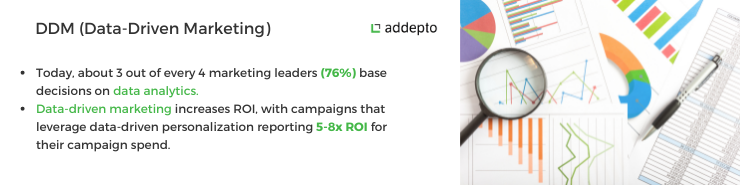
The first mass marketing campaigns were based solely on reach. It was a big challenge to define your target audience — there were no tools to do that, so you just had to go far and wide with your ad. Eventually, it reached potential customers, but it was far from an effective strategy. Things changed when marketers began gathering data about customers and the market itself and started analyzing it. In marketing, as nowhere else, data means precision.
Big Data: The Raw Material Behind Marketing BI
Before getting to what BI does with it, it’s worth being precise about what “big data” actually is here — not a synonym for BI, but the input it works on.
Big data is everywhere. One of the most interesting aspects of big data analytics is its ability to extract data from disparate sources — Twitter mentions, sales records — and combine them to create interpretations based on given parameters.
When it comes to marketing BI, big data helps businesses by providing valuable insights about their customers and potential clients. It also helps marketers understand why their efforts aren’t helping the company grow and where money is leaking. With big data and business intelligence in marketing, marketers can maximize efforts to increase profits and optimize critical workflows.
What types of big data are important for marketers?
| Data type | What it covers | Typical sources |
|---|---|---|
| Customer data | Understanding your target audience | Social media activity, surveys, online communities |
| Financial data | Measuring productivity and efficiency | Sales and marketing statistics, costs, margins, competitor pricing |
| Operational data | Understanding business processes | Shipping, logistics, CRM, hardware sensor feedback |
Where do marketers apply big data?
Almost everywhere. Customer analytics (48%), fraud and compliance (12%), new product and service innovation (10%), and enterprise data warehouse optimization (10%) are among the most popular use cases in sales and marketing — leading to improvements in SEM, SEO, social media advertising, OOH advertising, and mailing campaigns.
Big data is the raw material; it’s business intelligence that combines and analyzes it and turns it into useful knowledge.
Tools for Turning Big Data Into Marketing Decisions
This is the bridge between the two: applying BI tools to the big data described above usually means combining a few categories, not relying on one.
| Category | What it does | Example tools |
|---|---|---|
| Analytics platforms | Measure traffic, conversions, and campaign performance | Google Analytics (with its AI-based Analytics Intelligence module), Microsoft Power BI |
| Data integration & preparation | Gather data from multiple sources into one accessible location, clean it for analysis | CloverETL, Talend Open Studio, DataWatch |
| Data quality | Remove formatting errors, typos, and redundancies that distort results | Cloudingo, Data Ladder, Informatica Master Data Management |
| Data governance | Keep data integrity and security intact as it’s used across teams | Xplenty, Collibra, IBM Data Governance |
Google Analytics is usually the starting point — it’s free, and its Analytics Intelligence module can answer direct questions (“which channel had the highest conversion rate last month?”) without manual report-building. Power BI extends this to non-technical business users who need to aggregate and visualize marketing data without writing queries themselves.
Business intelligence in marketing
There are three main fields in which business intelligence is beneficial for sales and marketing:
Research. Business intelligence, especially with information stored by social media, gives marketers granular detail on consumer behavior and interests — enough to identify new target audiences and new marketing opportunities, like emerging niches or in-demand products.
Analysis. Analyzing big data with no AI algorithms is time-consuming, and at some scale, impossible. Business intelligence in marketing makes it doable — AI algorithms analyze tons of data within seconds, letting you make quick modifications to keep a campaign as profitable as possible.
Savings. Because business intelligence algorithms handle most of the analytical work, you need fewer employees for it. This also lets you shift from traditional employment toward cooperation with agencies, freelancers, and BI consulting companies.

To sum this up: business intelligence is essential for marketing. Marketing BI makes campaigns more accurate and tailored to audience needs — which means higher income in a shorter time.
Continuous Intelligence: The Next Step Beyond Dashboards
Beyond standard BI reporting, a related trend worth knowing is Continuous Intelligence (CI) — integrating real-time analytics directly with business operations rather than reviewing a dashboard after the fact. CI applications process historical and current data simultaneously to support decisions as they’re being made, built on augmented analytics.
Gartner projected that over 50% of new business systems would use CI by the end of 2022. For marketing specifically, that means real-time personalization of offers and discounts, and faster, more responsive customer support — decisions made as the data arrives, not the next time someone opens a report.
How to implement business intelligence in marketing?
Business intelligence for marketing isn’t yet common across the industry. One survey found that 43% of marketers cite the cost of advanced data science as the biggest barrier to investing in it. Most who struggle get stuck on the same three questions: where to start, which operations to prioritize, and how long before results show. Here’s how to answer each one.
STEP 1: Start With KPIs, Not Tools
Define your KPIs before you touch any tool. BI is a tool, not a magic wand — its biggest strength is sorting through massive amounts of data and generating insights you can act on, but only once you know what you’re asking it. Without a defined metric, “analyze our data” isn’t a starting point; it’s a request with no destination.
STEP 2: Prioritize Your Existing Channels or Your Website First
Two starting points work well:
- Your existing marketing channels — if tools are already in place, start with the ones generating the most volume or spend.
- A primary analysis of your own website — visitor counts, time on page, which pages get viewed, and where traffic originates.
Either path tends to surface the same thing: clear strengths and weaknesses that tell you what to fix next.
STEP 3: Expect Results Within Days of Acting on the Data
BI on its own doesn’t produce improvements — it’s an instrument that shows you what should change. Acting on that is still your job. But once you do act on it, the first results are typically visible within days, not months.
How can business intelligence be useful in marketing?
Use business intelligence in marketing wisely: indicate KPIs, ask the right questions, and you’ll get valuable knowledge about the marketing activities you’re already running. Here’s where it concretely helps:
Customer Data
BI can integrate a company’s entire customer information into one centrally managed system, tracking data from CRM, email marketing, social media campaigns, and website interactions. Combining data mining, analysis, and visualization gives executives a comprehensive view of corporate data for more informed decisions — and helps analyze customer behavior and market trends to improve delivery and supply chain effectiveness.
Predictive analytics
Predictive analytics reveals future trends by analyzing existing data, supporting the sales team’s approach and helping increase revenue. It doesn’t just recommend the best message for a customer based on past behavior — it can tell a company which products to sell to which customers, and, combined with BI tools, provide near-real-time updates that accelerate or automate parts of decision-making and execution.
Personalized sales strategy
BI in marketing helps companies build better, more targeted sales strategies using data about a target company’s turnover, budget plans, expansion strategy, sales figures, and competitors — supporting the sales and marketing teams in evaluating opportunities and preparing quotations. Applied well, it helps teams concentrate on attracting high-quality customers and improving everything from conversion rates to the bottom line.
“Business intelligence has become a game-changer for us in refining our sales strategies. Early on, we faced challenges in understanding which marketing efforts truly resonated with our target audience. To solve this, we turned to advanced analytics tools to track customer behaviors and preferences across multiple channels. This allowed us to segment our audience more effectively and tailor our outreach accordingly. As a result, we saw a 25% increase in lead conversion rates and a 15% boost in customer retention.”
— George El-Hage, CEO of Wave Connect
Reporting process
Reporting is the most essential business application of BI — data is transformed into simple, usable information through reporting and analysis, which helps businesses increase productivity and gain control over operations. With a faster reporting process, marketers stop wasting time reconciling data streams and manually adjusting calculations.
Real-life examples of business intelligence in marketing
Here’s how it works in real-life conditions, across companies of very different sizes and sectors:
Chipotle Mexican Grill
Chipotle, an American restaurant chain with over 2,400 locations, was struggling to track restaurant operational effectiveness. A centralized BI application gave them accurate tracking of every restaurant’s operational efficiency at a national scale — saving thousands of hours and letting them manage the entire business more efficiently.
HelloFresh
HelloFresh’s previous digital marketing reporting system was slow and inefficient. A centralized business intelligence solution saved the marketing analytics team 10-20 working hours per day by automating reporting — and the real-time data it provided showed far more accurate customer behavior statistics, letting the team optimize campaigns. Conversion rates and customer retention both grew noticeably.
Coca-Cola Bottling Company (CCBC)
CCBC, Coca-Cola’s largest independent bottling partner, was struggling with manual reporting processes that restricted access to real-time sales and operations data, slowing the company down. After implementing BI, the team automated manual reporting — saving over 260 hours a year, more than six 40-hour workweeks.
American Express
American Express uses business intelligence to develop new payment services and market offers. Testing in Australia let them identify up to 24% of Australian users who close their accounts within four months — data they now act on to retain clients. BI also helps the company detect fraud and protect customers whose card information could be compromised.
Netflix
With over 209 million subscribers, Netflix uses data across the business — including developing and validating new programming concepts based on what’s already been watched. Its recommendation algorithm is effective enough that it drives over 80% of all streaming content watched on the platform.
Evolv (now Cornerstone)
Evolv helps large global corporations make better HR and management decisions through predictive analytics, factoring in over 500 million data points — including gas prices, unemployment rates, and social media usage — to help clients cut attrition and predict when an employee is likely to leave. The approach worked: Evolv’s sales grew 150% in a single year (Q3 2012 to Q3 2013).
Airbnb
Airbnb found in 2014 that users from several Asian countries had unusually high bounce rates on its homepage. Digging into the data, they found users were clicking a “Neighborhood” link, browsing photos, and never returning to book. Airbnb replaced the link with top travel destinations specific to those markets (China, Japan, South Korea, Singapore) — a single, targeted change that produced a 10% increase in conversions.
Addepto
For one of our own SaaS clients, we built a self-service interactive dashboard analyzing customer data, alongside a customized machine learning system for churn prediction, sales predictions, and recommendation systems — with tailor-made data integration for both structured and big data sources, unified in one data warehouse and fully integrated with the client’s existing software. Results: a 19% increase in sales and an 11% increase in customer retention within six months.
Results at a glance
| Company | What they did | Result |
|---|---|---|
| Coca-Cola Bottling Company | Automated manual reporting | 260+ hours saved per year |
| Nestle | Behavioral scoring for pet-owner targeting | 300% increase in conversion rate, 90% lower cost-per-acquisition |
| American Express | Predictive account-closure modeling | Identified 24% of at-risk accounts in test market |
| Evolv (Cornerstone) | Predictive HR/attrition analytics | 150% sales growth in one year |
| Airbnb | Localized homepage UX based on bounce data | 10% increase in conversions |
| Addepto client (SaaS) | Unified BI dashboard + ML churn/sales prediction | 19% more sales, 11% better retention in 6 months |
Business Intelligence in marketing – for your company
Business intelligence is a significant enhancement to how a company operates: it helps you reach current and potential customers faster and more accurately, improves analytics and reporting, and helps manage a company even when it’s spread across the globe.
If this sounds like something your marketing team needs, Addepto’s business intelligence services team can help you figure out where to start and what results are realistic for your data. Get in touch and let’s talk about implementing BI in your marketing.
This article is an updated version of the publication from Jun 6, 2021.
FAQ
What is Data-Driven Marketing (DDM)?


Data-Driven Marketing (DDM) is an approach that relies on data analysis to make informed marketing decisions. This method allows marketers to precisely target their audience and create more effective campaigns.
How has the use of data transformed marketing?
The use of data has revolutionized marketing by enabling precise targeting and efficient decision-making. Data-driven marketing campaigns report significantly higher ROI, with personalization efforts yielding 5-8 times the return on investment.
What is big data, and how is it used in marketing?
Big data refers to the vast volumes of data generated from various sources. In marketing, it is used to gain insights into customer behavior, identify market trends, and optimize marketing efforts to increase profitability and efficiency.
What types of big data are important for marketers?
Marketers focus on three types of big data:
- Customer Data: Information about target audiences from social media, surveys, and online communities.
- Financial Data: Metrics related to sales, marketing statistics, costs, and margins.
- Operational Data: Information about business processes, such as shipping, logistics, and customer relationship management.
Where do marketers apply big data?
Big data is applied in various areas, including customer analytics, fraud and compliance detection, new product and service innovation, and enterprise data warehouse optimization. These applications lead to improvements in search engine marketing (SEM), search engine optimization (SEO), social media advertising, out-of-home (OOH) advertising, and mailing campaigns.
What are the benefits of using business intelligence in marketing?
- Research: Provides detailed insights into consumer behavior and interests, helping identify new target audiences and marketing opportunities.
- Analysis: AI algorithms quickly analyze large volumes of data, allowing for real-time modifications to marketing campaigns.
- Savings: Reduces the need for a large workforce and enables outsourcing, leading to cost savings and increased efficiency.
How can a company implement business intelligence in marketing?
- Start by asking the right questions: Define key performance indicators (KPIs) and metrics to guide your BI efforts.
- Prioritize operations: Focus on existing marketing channels or begin with a primary analysis of your website’s performance.
- Expect results: Once BI tools are implemented and changes are made, initial results should be visible within days.
How can business intelligence be useful in marketing?
- Customer Data Integration: Combines data from various sources to provide comprehensive insights into customer behavior and market trends.
- Predictive Analytics: Uses data to forecast future trends and inform sales strategies, helping increase revenue.
- Personalized Sales Strategy: Provides detailed information about target companies, aiding in the preparation of tailored sales strategies.
- Reporting Process: Simplifies data into usable insights, increasing productivity and control over operations.
How is generative AI used in marketing BI?
Generative AI is used in marketing BI in five main patterns: (1) content generation at scale (drafting emails, ad copy, social posts, images, video — using GPT-5, Claude Opus 4, Gemini 2.5 Pro, DALL-E 3, Sora); (2) natural-language analytics where marketers ask dashboards questions in plain English (Snowflake Cortex, Databricks AI/BI Genie, Power BI Copilot, Tableau Pulse); (3) AI explanations of classical ML predictions, making churn/LTV/propensity scores actionable for non-technical marketers; (4) RAG-based marketing knowledge assistants grounded in your own brand guidelines, past campaigns, and customer research; and (5) AI agents that automate multi-step marketing workflows with human approval gates.
What is a Customer Data Platform (CDP) and why does it matter for marketing BI?
A Customer Data Platform (CDP) unifies customer data from every touchpoint — web, app, email, ads, point-of-sale, customer service — into a single persistent customer profile. The leading platforms in 2026 are Segment (Twilio), mParticle, Treasure Data, Tealium, and Salesforce Data Cloud. CDPs matter because the AI features of modern marketing only work as well as the underlying customer data — and most enterprises have customer data fragmented across 30+ systems. A CDP is the foundation that makes personalization, predictive analytics, and AI-driven marketing reliable.
How does the EU AI Act affect marketing automation?
The EU AI Act, in force since August 2024 and being phased in through 2026–2027, classifies AI systems by risk tier. Many marketing AI applications — automated price personalization, AI-driven content moderation, marketing decisions in regulated sectors (financial services, healthcare, insurance), and emotion recognition in marketing — fall into the “high-risk” category, triggering documentation, transparency, human-oversight, and post-market monitoring requirements. Marketing teams using AI in the EU now need to consider these obligations as part of their stack design, not as an afterthought.
What happens to marketing BI as third-party cookies disappear?
The deprecation of third-party cookies has been gradual but real, and the response has been a fundamental shift toward first-party data strategies: investing in CDPs to unify owned customer data, building consented data-collection mechanisms (preference centers, value-exchange offers), using server-side tracking, exploring clean room collaborations (Google Ads Data Hub, Amazon Marketing Cloud, LiveRamp) for measurement, and leaning more heavily on probabilistic modeling rather than deterministic identity. Marketing BI in 2026 is built on first-party data as the foundation, with third-party signals as an increasingly weak supplement.
Category: