March 12, 2026
What is Entropy in Machine Learning?


Entropy in machine learning is a mathematical measure of uncertainty or disorder in a probability distribution — originating from Claude Shannon’s 1948 information theory. It quantifies how unpredictable a random variable is: low entropy means outcomes are highly predictable, high entropy means they’re close to uniformly random. In ML, entropy sits at the core of three foundational areas: decision trees (choosing data splits via information gain), classification loss functions (cross-entropy, which trains nearly every neural network classifier in 2026), and generative AI sampling (where temperature, top-k, and top-p sampling are all entropy-based controls over the randomness of model outputs).

Key Takeaways
- Entropy is a mathematical measure of uncertainty in a probability distribution — defined by Shannon’s formula: H(X) = −Σ p(x) log p(x).
- Low entropy means outcomes are predictable (a coin biased 99% to heads); high entropy means outcomes are close to uniformly random (a fair coin or fair die).
- In decision trees, entropy combined with information gain determines the best feature to split on at each node — the split that most reduces uncertainty wins.
- Cross-entropy loss is the standard training objective for almost every neural network classifier and language model in 2026 — including the LLMs (GPT-5, Claude Opus 4, Gemini 2.5 Pro) that dominate generative AI.
- In LLM inference, entropy is what temperature, top-k, and top-p (nucleus) sampling control — they regulate how random vs deterministic the model’s output is.
- Reducing entropy isn’t always the goal. Some applications (creative writing, exploration in reinforcement learning, sampling in generative models) deliberately preserve entropy to avoid premature convergence and rigid outputs.
How Entropy Works in Machine Learning?
In physics, entropy measures the randomness in a closed system. Similarly, in machine learning, entropy gauges the disorder in processed information. Lower entropy signifies that data is easier to interpret and yields more valuable insights, while higher entropy suggests unpredictability and complexity.
Interested in machine learning? Read our article: Machine Learning. What it is and why it is essential to business?
Shannon’s entropy formula
Mathematically, entropy is defined by Shannon’s formula from his foundational 1948 paper A Mathematical Theory of Communication:
H(X) = −Σᵢ p(xᵢ) log₂ p(xᵢ)
Where:
- H(X) is the entropy of the random variable X
- p(xᵢ) is the probability of outcome xᵢ
- log base 2 gives the result in bits — the standard unit in information theory; using natural log gives nats, log base 10 gives dits
- The negative sign ensures entropy is non-negative (the log of a probability between 0 and 1 is negative)
A few key properties make this formula useful in machine learning:
- Entropy is zero when one outcome has probability 1 — there’s no uncertainty
- Entropy is maximal when all outcomes are equally likely (a uniform distribution) — uncertainty peaks
- For a binary outcome with probability p, entropy simplifies to: H = −p log₂(p) − (1−p) log₂(1−p) — peaking at exactly 1 bit when p = 0.5
Illustrating Entropy with a Coin Toss
Consider three coins and what entropy tells us about each:
A fair coin (p = 0.5 for heads, p = 0.5 for tails):
H = −0.5 × log₂(0.5) − 0.5 × log₂(0.5) = 1 bit
Each toss carries exactly 1 bit of information — the maximum possible for a binary outcome. The result is maximally uncertain.
A biased coin (p = 0.9 for heads, p = 0.1 for tails):
H = −0.9 × log₂(0.9) − 0.1 × log₂(0.1) ≈ 0.47 bits
Outcomes are mostly predictable, so each toss carries less information — about half a bit.
A trick coin (p = 1.0 for heads):
H = −1.0 × log₂(1.0) − 0 = 0 bits
No uncertainty, no information. Every toss is fully predictable.
This is exactly the intuition machine learning relies on: predictable data is “low information” and easy to model; unpredictable data is “high information” and harder to classify or compress.
It might be interesting for you: Machine Learning models
Entropy in Decision Trees
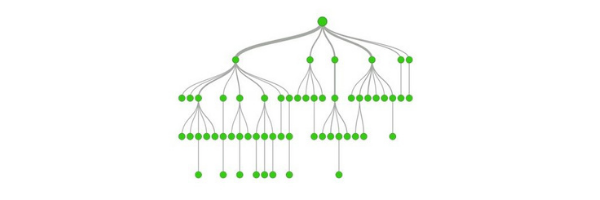
Decision trees — used in classification and regression, and as building blocks of random forests and gradient boosting (XGBoost, LightGBM, CatBoost) — use entropy to decide how to split data at each node.
The mechanism is information gain (IG) — the reduction in entropy after splitting on a feature:
IG(parent, split) = H(parent) − Σ (|childᵢ| / |parent|) × H(childᵢ)
In plain English: information gain measures how much uncertainty a split removes. At each node, the tree:
- Calculates the entropy of the current data
- For each candidate feature, calculates the weighted entropy of the resulting child nodes
- Picks the feature with the highest information gain — the one that most reduces uncertainty
- Repeats recursively until a stopping criterion is met
A simple example. Suppose a node has 10 samples — 5 positive, 5 negative. The entropy is 1 bit (maximum). If a candidate feature splits the data into two pure groups (5 positive in one, 5 negative in the other), both children have entropy 0. Information gain is 1 − 0 = 1 bit — the maximum possible. That split would be chosen.
If instead the split produces a 4/3 ratio in one child and 1/2 in the other, both children still have nontrivial entropy, and information gain is smaller. The tree would prefer the cleaner split.
Some tree algorithms use Gini impurity instead of entropy — it’s faster to compute and gives very similar results in practice. The decision between Gini and entropy rarely changes which model wins, but the underlying logic is the same: pick the feature that produces the most informative split.
 Source: opendatascience.com
Read more about Decision Tree Machine Learning Model
Cross-entropy: how neural networks actually learn
Beyond decision trees, the most consequential use of entropy in modern machine learning is cross-entropy loss — the training objective used by nearly every neural network classifier and language model in production today, from image classifiers to LLMs like GPT-5, Claude Opus 4, and Gemini 2.5 Pro.
Cross-entropy measures the difference between two probability distributions: the true distribution (what the data actually shows) and the predicted distribution (what the model predicts). The formula:
H(p, q) = −Σ p(x) log q(x)
Where p is the true distribution and q is the model’s predicted distribution.
The intuition: cross-entropy is high when the model assigns low probability to outcomes that actually occur — that is, when the model is confidently wrong. Training a neural network by minimizing cross-entropy pushes the predicted distribution closer to the true distribution.
Two specific variants dominate in practice:
- Binary cross-entropy — used for binary classification (spam vs not spam, fraud vs legitimate)
- Categorical cross-entropy — used for multi-class classification (image classification, language modeling where the “classes” are vocabulary tokens)
A closely related concept, KL divergence (Kullback-Leibler divergence), measures how much one distribution diverges from another — and is foundational in variational autoencoders (VAEs), reinforcement learning (policy gradient methods like PPO), and the post-training of LLMs (reward modeling and RLHF). KL divergence and cross-entropy are tightly linked mathematically: minimizing cross-entropy with respect to the model’s parameters is equivalent to minimizing KL divergence between the true and predicted distributions.
Entropy in LLM sampling: temperature, top-k, top-p
The most visible use of entropy in 2026 is in how large language models generate text. When an LLM predicts the next token, it produces a probability distribution over its entire vocabulary (typically 50,000–200,000 tokens). The sampling strategy that turns that distribution into actual output text is essentially entropy control.
Temperature
Temperature is a parameter that flattens or sharpens the probability distribution before sampling:
- Temperature = 0: the model always picks the most likely token. Entropy is effectively zero. Output is deterministic, predictable, and often repetitive.
- Temperature = 1: the model samples from the original distribution. Entropy is whatever the model produces naturally.
- Temperature > 1: the distribution is flattened — lower-probability tokens become relatively more likely. Entropy rises. Output is more creative, but also more error-prone.
Most production applications use temperature between 0.1 and 0.7 — preserving some creativity while keeping outputs grounded.
Top-k sampling
Instead of sampling from the full vocabulary, top-k restricts the model to the k most likely tokens at each step (typical values: k = 20 to 50). This caps entropy by removing the long tail of low-probability options. Higher k means more entropy; lower k means more determinism.
Top-p (nucleus) sampling
Top-p (also called nucleus sampling) is more adaptive. Instead of fixing a number of candidates, it selects the smallest set of tokens whose cumulative probability exceeds a threshold p (typically 0.9–0.95). When the model is confident (low entropy), the candidate set is small; when the model is uncertain (high entropy), the set widens.
Why this matters in practice
The same LLM can produce factual, deterministic answers at temperature 0.1 — and creative, varied story output at temperature 0.9. Both are valid, depending on the use case. Picking the right entropy-control parameters is one of the most common tuning decisions for production LLM applications — and it’s all just classical Shannon entropy applied to the model’s output distribution.
Why entropy matters strategically in ML projects
Beyond the mathematics, entropy directly affects how machine learning projects succeed or fail in production:
- Feature selection. Features with high information gain (large reduction in entropy) are the ones that actually help models predict. Identifying them early — by measuring entropy and information gain on candidate features — focuses engineering effort where it matters.
- Data quality and labeling. Datasets with very high entropy in the label distribution are often a sign of inconsistent labeling, noisy data collection, or genuinely hard problems. Diagnosing high entropy early can prevent months of wasted training time.
- Model evaluation. Cross-entropy on a held-out test set is the standard quality metric for classifiers — it’s more sensitive to overconfidence and confidence calibration than raw accuracy.
- LLM behavior in production. Choosing the right temperature and sampling parameters is essentially an entropy-control decision. Customer support assistants typically run at low entropy (deterministic, factual); creative writing tools at high entropy.
- Reinforcement learning. Many modern RL algorithms (PPO, A3C, SAC) explicitly add an entropy bonus to the loss function — rewarding the agent for exploring rather than collapsing prematurely onto a single strategy. The same principle has shown up in RLHF for training LLMs.
The takeaway: entropy isn’t an abstract mathematical curiosity in machine learning — it’s a tool that shows up in feature engineering, training, evaluation, and inference. Teams that understand it tend to make better decisions about model design and deployment.
Conclusion
Entropy is one of the few concepts in machine learning that crosses cleanly between classical and modern AI. It started with Shannon’s 1948 information theory; it powers decision trees and gradient boosting; it’s the loss function (as cross-entropy) used to train almost every classifier and language model in production; and it’s the parameter (as temperature, top-k, and top-p) that controls how generative AI behaves at inference time.
For ML practitioners, understanding entropy isn’t optional — it shows up in feature selection, model training, evaluation, and inference tuning. For business leaders building AI strategy, the takeaway is simpler: the same mathematical concept underlies how decision trees pick features, how neural networks learn, and how LLMs produce outputs. Investing in the data quality and labeling that reduce irrelevant entropy almost always pays off downstream.
If you’d like help designing or improving machine learning systems — from classical decision-tree models to LLM-powered applications — book a 30-minute call with our team. We help enterprises across manufacturing, finance, healthcare, aviation, and retail build ML systems that deliver measurable business outcomes. You can also explore our Machine Learning Consulting, AI Consulting, and MLOps Consulting services for a closer look at our approach.
This article was updated Mar 12, 2026, to insert the FAQ section.
References
[1] Shannon, C. E. A Mathematical Theory of Communication. Bell System Technical Journal, 1948. (The foundational paper defining entropy in information theory.) URL: https://people.math.harvard.edu/~ctm/home/text/others/shannon/entropy/entropy.pdf. Accessed March 12, 2026
[2] scikit-learn documentation. Decision Trees — entropy and information gain. URL: https://scikit-learn.org/stable/modules/tree.html. Accessed March 12, 2026
[3] Goodfellow, I., Bengio, Y., Courville, A. Deep Learning. MIT Press, 2016. (Chapter 3.13 — Information Theory; covers entropy and cross-entropy in the context of neural networks.) URL: https://www.deeplearningbook.org/. Accessed March 12, 2026
[4] Holtzman, A. et al. The Curious Case of Neural Text Degeneration. (Original paper introducing nucleus / top-p sampling for language models.) URL: https://arxiv.org/abs/1904.09751. Accessed March 12, 2026
[5] Schulman, J. et al. Proximal Policy Optimization Algorithms. (PPO paper — references entropy bonus in reinforcement learning.) URL: https://arxiv.org/abs/1707.06347. Accessed March 12, 2026
FAQ
How is entropy different from variance or noise in a dataset?


Entropy measures uncertainty in the distribution of outcomes — how unpredictable they are. Variance measures how far numerical values spread from their average — a measure of dispersion in continuous data. Noise is unwanted or random information that obscures the underlying signal. These can coexist independently: a dataset can have low variance but high entropy if class labels are unpredictable, or high variance with low entropy if values spread widely but follow a clear pattern. In practice, entropy is most relevant when the target variable is categorical; variance dominates for regression problems.
Can high entropy ever be useful in machine learning?
Yes. High entropy can signal rich complexity or hidden patterns worth exploring, especially early in analysis. It is not always bad, but models usually need techniques such as feature engineering, better labeling, or more data to turn that uncertainty into useful structure.
Why do decision trees use entropy instead of choosing splits randomly?
Random splits can separate data poorly and produce weaker predictions. Entropy gives a mathematical way to compare candidate splits and choose the one that reduces uncertainty the most, helping the tree become simpler, faster, and more accurate.
Does reducing entropy always improve model performance?
Not necessarily. Reducing entropy can improve clarity, but too much simplification may remove important information and lead to underfitting. The goal is to reduce irrelevant uncertainty while preserving meaningful patterns in the data.
How can businesses reduce entropy in real ML projects?
They can improve data quality, standardize data collection, remove duplicates, fill missing values carefully, and select more relevant features. Clearer business goals and better labeled training data also help models learn more reliable patterns.
What's the difference between entropy and cross-entropy?
Entropy measures uncertainty in a single probability distribution — for example, how unpredictable the class labels in a dataset are. Cross-entropy measures the difference between two distributions: the true distribution (what’s actually in the data) and the predicted distribution (what a model outputs). Cross-entropy is high when the model assigns low probability to outcomes that actually occur — that is, when it’s confidently wrong. Training a neural network classifier by minimizing cross-entropy is mathematically equivalent to making the model’s predicted distribution match the true distribution as closely as possible. Almost every neural network classifier and language model in 2026 — including LLMs like GPT-5, Claude Opus 4, and Gemini 2.5 Pro — is trained by minimizing cross-entropy.
How does entropy control LLM output through temperature?
When a large language model generates text, it produces a probability distribution over its vocabulary at every step. Temperature is a sampling parameter that controls the entropy of that distribution: low temperature (close to 0) sharpens the distribution and makes outputs deterministic; high temperature (above 1) flattens the distribution and makes outputs more random and creative. Most production applications use temperature between 0.1 and 0.7 — preserving some flexibility while keeping outputs grounded. Top-k and top-p (nucleus) sampling are related techniques that also control entropy by restricting which tokens the model can sample from.
How is entropy used in reinforcement learning?
In reinforcement learning, entropy regularization is a common technique to encourage exploration. Many modern RL algorithms (PPO, A3C, SAC) add an entropy bonus to the loss function — rewarding the policy for keeping action distributions less concentrated. Without this bonus, an RL agent can collapse onto a single strategy too quickly and miss better solutions further out in the search space. The same principle appears in RLHF (reinforcement learning from human feedback) used to align LLMs — preserving some entropy prevents the model from becoming overly rigid or producing repetitive outputs after fine-tuning.
Category: