July 28, 2025
ContextClue Relaunch: AI Assistant for Engineering and Manufacturing Knowledge Management


At Addepto, we believe that artificial intelligence should not only generate content but also help organizations solve real operational challenges.
Over the last few years, AI adoption has accelerated across many sectors. Yet engineering and manufacturing remain among the most complex and under-supported domains. Effective AI solutions for the manufacturing industry must understand specialized technical data, integrate with systems such as CAD, PLM, ERP, and MES, and support real operational processes rather than provide only generic conversational capabilities.
This gap inspired us to reimagine and relaunch ContextClue as a platform explicitly designed for the needs of industrial environments.
Key Takeaways
- Engineering and manufacturing environments require AI systems that understand technical documentation and operational context.
- Generic AI assistants are insufficient for industrial workflows involving CAD, PLM, ERP, and MES systems.
- Combining LLMs, knowledge graphs, and semantic search creates a much richer knowledge environment than standalone chatbots.
- AI-powered knowledge retrieval accelerates troubleshooting, commissioning, and engineering decision-making.
- Knowledge graphs connect information across multiple enterprise systems, improving context and traceability.
- Modular AI platforms allow organizations to introduce capabilities gradually without replacing existing infrastructure.
- Real-world deployments demonstrate measurable improvements in engineering productivity and production readiness.
- The future of industrial AI lies in combining generative AI with structured enterprise knowledge.
Why Engineering Needed a Different Approach
While generative AI has made remarkable progress in producing summaries, recommendations, and conversational responses, these capabilities alone are not sufficient in production settings.
Engineering teams typically face three core challenges:
- Fragmented and highly technical data: Information is scattered across CAD drawings, PLM records, ERP systems, maintenance logs, and a long tail of legacy documentation. Unlike typical business documents, engineering content is detailed, specialized, and often context-dependent.
- Limited search and retrieval capabilities: Conventional document management systems rely on keyword-based search and static taxonomies, making it difficult for engineers to locate relevant information when it’s needed most.
- Lack of intelligent automation: Even when teams succeed in collecting data, they often lack tools to connect, interpret, and use this information to automate processes such as troubleshooting, commissioning, and predictive maintenance.
Through extensive consultation with manufacturing leaders and engineering professionals, it became clear that generic AI assistants are not equipped to address these issues. ContextClue was re-envisioned to close this gap.
A Platform Reimagined for Industrial Needs
The updated version of ContextClue represents a significant shift from earlier iterations of our knowledge assistant. Organizations comparing the top AI enterprise knowledge management tools should evaluate not only conversational capabilities but also source-system integrations, semantic retrieval, knowledge verification, permissions, and support for complex operational contexts. ContextClue is not just a generative AI solution but a modular environment that brings together multiple technologies, including:
-
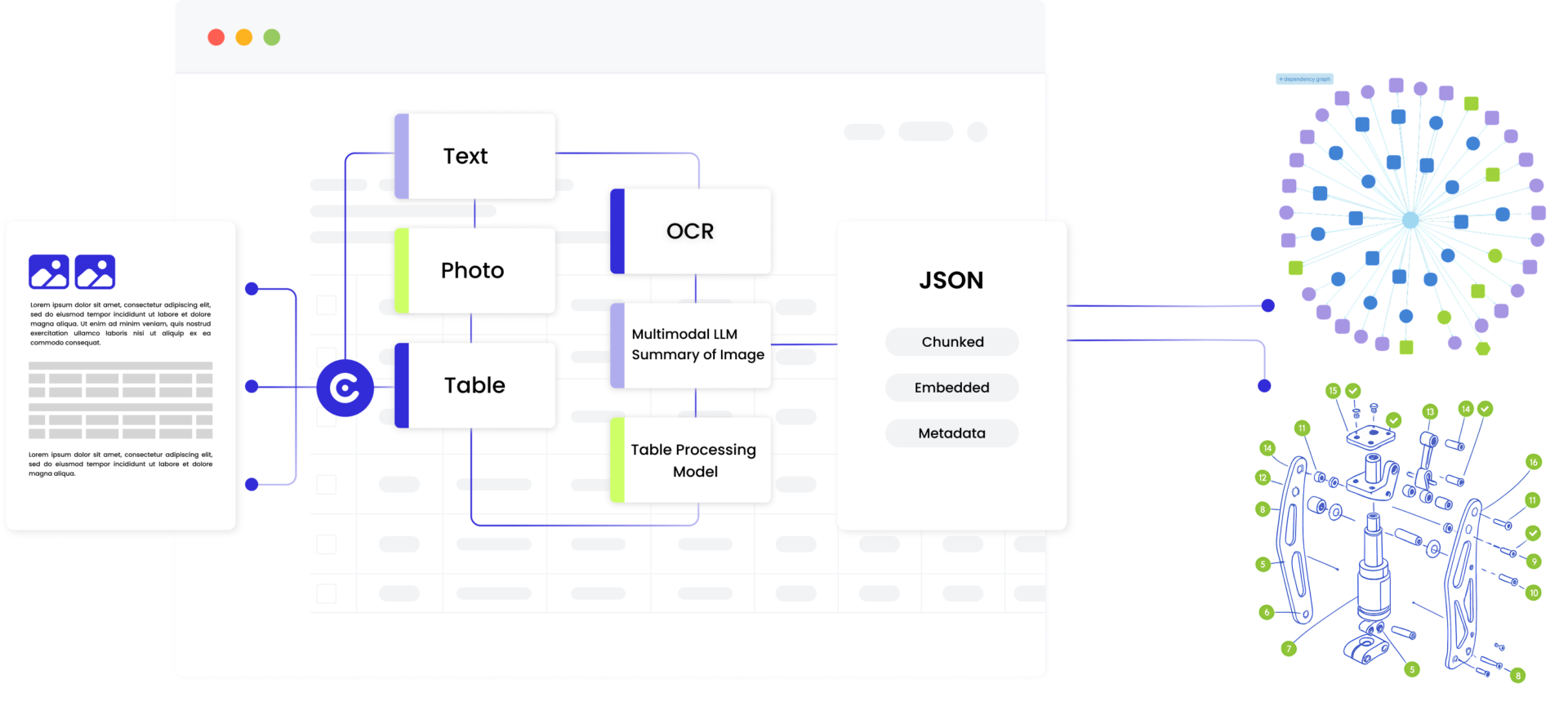
- Generative AI: Large language models (LLMs) trained to understand and produce technical content, enabling the creation of summaries, explanations, and recommendations tailored to engineering workflows.
- Knowledge graphs: Semantic representations of data that link documents, system records, and historical information into a unified context. A knowledge graph-powered AI implementation in product engineering allows teams to connect components, requirements, technical documentation, dependencies, historical decisions, and operational data, helping engineers understand how processes and design choices are interrelated.
- Semantic search and retrieval engines: Advanced algorithms capable of interpreting queries in natural language and delivering precise, context-aware results – even when the information is spread across multiple formats and repositories.
- AI-powered knowledge bases: These capabilities come together in an AI-powered knowledge base, where semantic search, knowledge graphs, and retrieval-augmented generation (RAG) enable engineers to access trusted information across complex enterprise environments.
- Automation capabilities: Tools that help organizations build digital twins, develop predictive maintenance workflows, and accelerate time-consuming processes such as virtual commissioning.
Supporting Complex Use Cases
By combining generative AI, knowledge graphs, and semantic retrieval, ContextClue helps engineering and manufacturing teams address some of their most complex challenges. The platform can automatically ingest and structure information from diverse sources, including CAD files, technical manuals, compliance records, and maintenance documentation.
With this unified foundation, organizations can develop digital twins that model equipment and processes in detail, improving situational awareness and supporting simulation efforts. Moreover, during virtual commissioning, ContextClue gives teams instant access to critical documentation and configuration histories, significantly reducing the time required to launch new production lines.
Beyond commissioning, the platform also supports predictive maintenance by analyzing operational data to detect early signs of equipment failure, as well as knowledge capture, enabling experienced engineers to record and share best practices in a structured, searchable format.
Early Results and Industry Validation
In a recent proof-of-concept deployment with a global automotive manufacturer, ContextClue demonstrated its ability to drive measurable results. The client needed to carry out virtual commissioning – digitally testing and validating the line before installation.
The process involved:
- CAD drawings, PLM records, and ERP data stored in multiple systems
- Historical logs and vendor manuals
- Tight deadlines for production readiness
ContextClue was implemented to:
- Ingest and organize thousands of documents from CAD, PLM, ERP, and other repositories
- Build a semantic knowledge graph linking related information
- Provide semantic search, so engineers could ask questions in natural language and instantly find relevant answers
- Enable collaborative access to documentation during commissioning sessions
This approach delivered measurable benefits:
- Over 40% reduction in troubleshooting time, accelerating issue resolution
- Improved coordination between engineering and operations teams
- Higher confidence in production readiness and project timelines

Read more: Virtual Commissioning for a Leading German Automotive Manufacturer
Flexible Deployment and Customization Options
One of the huge updates introduced with the relaunch of ContextClue is a new, more flexible purchasing model. Organizations can now choose to adopt the product as a fully integrated, all-in-one solution, combining ingestion, semantic search, and knowledge graph capabilities in a single environment.
Alternatively, companies can select and deploy individual modules independently – for example, starting with semantic search and later adding knowledge graphs or predictive maintenance features as their needs evolve.
This modular approach also supports deep customization, enabling each deployment to reflect specific data sources, workflows, and security requirements unique to the organization. Whether teams need a turnkey platform or a tailored combination of capabilities, ContextClue can be configured to fit diverse engineering and manufacturing environments.
A Focus on the Engineering Community
The relaunch of ContextClue is a direct response to the feedback we received from engineering leaders: they need AI solutions that do more than process text – they need systems that understand engineering data, respect industry standards, and integrate with existing workflows.
ContextClue is purpose-built to:
- Handle complex, specialized terminology and data formats.
- Integrate seamlessly with established ecosystems such as PLM and ERP.
- Support the modular addition of new capabilities as organizations mature in their AI adoption.
Unlike generic AI chatbots or off-the-shelf knowledge bases, ContextClue has been developed specifically for the demands of manufacturing, engineering, and production environments.
Looking Ahead
We believe that the future of engineering knowledge management will be defined by AI systems that combine the best of generative intelligence and structured knowledge representation. The relaunch of ContextClue is an important step in making that vision a reality.
Our tool is designed to serve as a foundation for intelligent, connected workflows that keep pace with the complexity of modern production.
If you’d like to learn more about the new version of ContextClue or discuss a pilot project, please visit: https://context-clue.com
FAQ
What makes an AI knowledge management platform different from a traditional document management system?


A traditional document management system primarily stores and organizes files. An AI knowledge management platform adds semantic search, natural-language querying, automated information extraction, and contextual relationships between documents, components, systems, and historical decisions. This allows users to retrieve knowledge based on meaning and operational context rather than exact keywords or folder structures.
Why are generic AI assistants often insufficient for engineering and manufacturing?
Generic AI assistants are usually designed around broad language tasks and may not understand specialized engineering terminology, technical file formats, component relationships, or operational dependencies. Industrial environments require systems that can connect information from CAD, PLM, ERP, MES, maintenance records, technical manuals, and other domain-specific sources.
How do knowledge graphs improve engineering knowledge management?
Knowledge graphs represent information as connected entities and relationships. They can link components with specifications, documents, maintenance events, suppliers, production processes, and engineering decisions. This structure gives users more context than a standalone document search and helps reveal dependencies that may otherwise remain hidden across separate systems.
Can ContextClue integrate with existing enterprise systems?
ContextClue is designed to work with existing data sources and enterprise environments rather than replace them. It can ingest and connect information from technical documents, CAD files, PLM records, ERP systems, maintenance logs, spreadsheets, and other repositories. The exact integration scope depends on the organization’s systems, data formats, security requirements, and selected deployment model.
Does an organization need to deploy every ContextClue capability at once?
No. The platform can be introduced gradually through a modular approach. An organization may begin with semantic search and document ingestion, then add knowledge graphs, advanced automation, predictive maintenance, or other capabilities as requirements and AI maturity develop.
How can organizations keep an AI knowledge base up to date?
Connected data sources should be synchronized through controlled ingestion and update processes. Documents and knowledge graph entities should retain metadata such as source, version, owner, approval status, and modification date. Critical technical information should also remain subject to review by responsible engineers or domain experts.
How should access to sensitive engineering knowledge be controlled?
Access permissions should reflect the organization’s existing roles, teams, and source-system controls. Users should retrieve only the documents and information they are authorized to access. Enterprise deployments should also include authentication, role-based access control, secure storage, logging, and audit trails for searches and generated responses.
How can teams verify that AI-generated answers are reliable?
Answers should be grounded in approved enterprise sources and accompanied by references to the documents or records used. Teams should evaluate retrieval accuracy and answer quality separately, test the system with real engineering questions, and define escalation rules for cases where sources are incomplete, contradictory, or uncertain.
What are the best initial use cases for an industrial AI knowledge platform?
Strong initial use cases are usually narrow, high-value processes where information is fragmented and employees spend significant time searching for answers. Examples include troubleshooting, virtual commissioning, technical document retrieval, maintenance support, engineering change analysis, compliance checks, and capturing knowledge from experienced specialists.
How can an organization measure the business value of ContextClue?
Relevant metrics may include search time, troubleshooting duration, commissioning time, repeated-question volume, response acceptance, document processing time, user adoption, and the number of issues resolved without escalation. Manufacturing organizations may also track downtime, engineering change cycle time, production readiness, and time required to onboard new technical employees.
Does an AI knowledge platform replace engineers and subject-matter experts?
No. The platform is intended to make expert knowledge easier to capture, connect, and access. Engineers and specialists remain responsible for validating critical information, interpreting complex situations, approving high-impact decisions, and maintaining the domain knowledge on which the system depends.
When should a company choose a custom knowledge graph implementation instead of an off-the-shelf knowledge tool?
A more customized implementation may be appropriate when the organization has unique engineering relationships, specialized data formats, complex product structures, strict integration requirements, or workflows that cannot be represented through standard configurations. The decision should consider expected business value, implementation complexity, internal expertise, security requirements, and long-term maintenance.
Category: