February 26, 2026
From Experimentation to Execution: How KMS Technology and Addepto are Redefining AI Readiness


In December 2025, KMS Technology — a U.S.-based Digital Engineering, Data, and AI services company headquartered in Atlanta — acquired Addepto, a leading AI and data consulting firm headquartered in Poland. In this exclusive interview, Chewie Quek, Chief Growth Officer at KMS Technology, and Edwin Lisowski, Chief Technology Officer at Addepto, share their perspectives on the AI transformation landscape, how enterprises can overcome industry-wide pain points, and what lies ahead for the market.
Key Takeaways
- Enterprise AI has shifted from experimentation to accountability — with KPIs tied to cost reduction, revenue uplift, and operational efficiency rather than PoC velocity.
- Data readiness and modern data governance have become the ultimate gatekeepers — without them, AI initiatives stall regardless of model choice.
- The competitive advantage is moving from the model to operationalization — as raw model intelligence plateaus, execution (MLOps, governance, integration) becomes the differentiator.
- CIOs must evolve from software deployers to workforce architects — AI agents are digital workers requiring roles, permissions, accountability, and workforce-style performance metrics.
- The next phase of AI value creation is reinvention, not just efficiency — AI-native products that generate revenue, redesigned workflows, and new business models replace the “faster paperwork” era.
- “Zero-Operations” companies are a direction, not a destination — exceptions, accountability, and compliance don’t disappear, but partners will be judged on operational outcomes rather than implementation alone.
AI TRANSFORMATION LANDSCAPE
What key trends and metrics are you currently seeing in global enterprises on their AI transformation journey?
Chewie Quek: We’re seeing a clear shift from AI experimentation to AI accountability. Three trends stand out. First, AI initiatives are increasingly tied to specific KPIs: cost reduction, revenue uplift and operational efficiency. Second, data readiness has become the ultimate gatekeeper; without modern data governance, AI stalls. Finally, C-suites are paying closer attention to technical debt, ensuring AI isn’t layered onto legacy systems without architectural discipline. The most common metrics include time-to-value for AI use cases, percentage of AI models successfully deployed into production, data quality scores, and the operational cost of maintaining AI systems post-deployment.
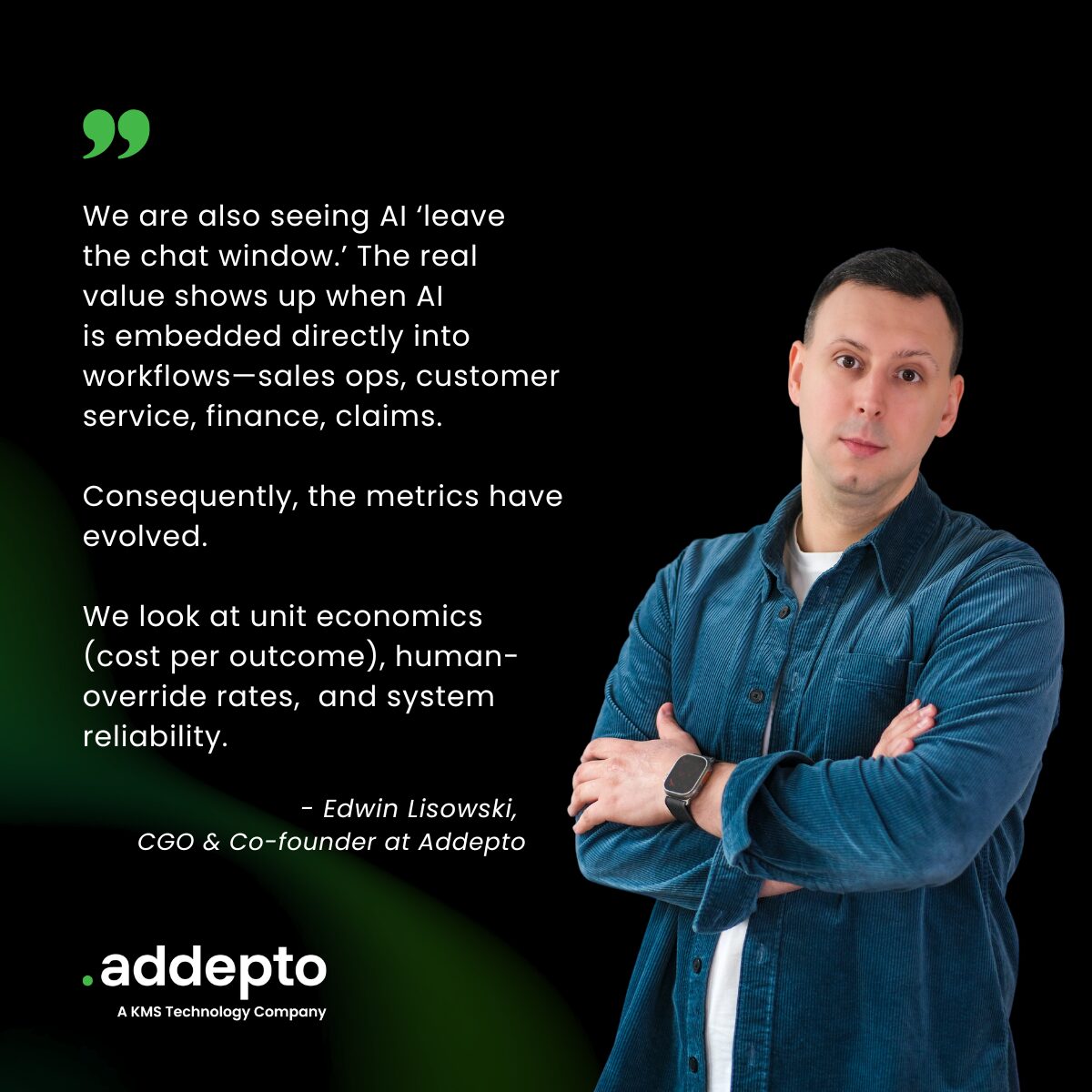
Edwin Lisowski: If you zoom out, the story is about making AI work reliably and at scale. Pilots are turning into portfolios. Leaders don’t want 20 experiments; they want 3–5 programs that move core KPIs. We are also seeing AI “leave the chat window.” The real value shows up when AI is embedded directly into workflows—sales ops, customer service, finance, claims. Consequently, the metrics have evolved. We look at unit economics (cost per outcome), human-override rates (to gauge quality), and system reliability.
From a C-level perspective, how do you benchmark an organization’s AI capabilities across the five most critical dimensions?
Chewie Quek: We assess maturity across five core dimensions: Data Foundation, Architecture & Platforms (MLOps), Talent & Operating Model, Use-case Prioritization, and Governance & trust. Organizations that score consistently across all five tend to move faster, incur less technical debt, and see AI as a long-term capability rather than a series of disconnected projects.
Edwin Lisowski: To add to that, you need a framework that is simple enough to govern but concrete enough to drive action. The “tell” is straightforward: how fast can you go from idea to production safely, and replicate that success across multiple domains without it turning into chaos.
How do KMS and Addepto’s combined offerings help companies prevent the technical debt that typically occurs when AI is added to legacy systems?
Chewie Quek: Technical debt often happens when AI is treated as an “add-on.” Together, we address this by designing AI into the digital core from the start. By aligning AI with long-term platform modernization, we help organizations modernize incrementally, avoiding the “hidden costs” that typically surface 12–24 months post-deployment.
Edwin Lisowski: Many transformations fail because AI is “patched” on, creating a fragile maze of scripts. Our joint approach treats AI as a first-class part of the architecture. We build clean integration patterns (APIs/events) and implement automated monitoring—quality gates, drift checks, and rollback paths—from day one, ensuring AI evolves without breaking the business.
INDUSTRY-WIDE PAIN POINTS
As raw model intelligence potentially plateaus—the “AI Wall”—does ‘AI Readiness’ become an operational race rather than a technology one?
Chewie Quek: Competitive advantage is shifting from the model to operationalization. It’s about how quickly a company can integrate AI into its decision systems and run those systems at scale. By focusing on the full AI value chain—modern data platforms, production-grade architecture, MLOps, and enterprise integration, we design end-to-end systems that allow AI to move from insight to action.
Edwin Lisowski: In a world where models are interchangeable, the winner is the one who runs AI best in production. We help clients build an “Operating System for AI”—reusable foundations and production discipline that make every subsequent deployment faster, cheaper, and safer. This means designing scalable and secure AI infrastructures for agent-oriented workflows from day one, not retrofitting them later. In a world where the model is not the differentiator, execution becomes the moat.
How should a CIO’s mindset evolve when they are effectively ‘hiring’ digital labor capable of planning its own actions?
Chewie Quek: This is a fundamental shift. AI systems are no longer passive tools; they are digital workers. CIOs must think less like software deployers and more like workforce architects. The question changes from ‘Does it meet requirements?’ to ‘How does this AI behave under uncertainty, how do we monitor its decisions, and how do humans stay in the loop?’
Edwin Lisowski: CIOs are moving from managing software to managing capacity. Agents aren’t features—they’re digital workers that can take actions, and change the governance model. You have to define roles, permissions, and accountability and measure performance like a team: success rate, exception handling, and ROI per workflow. If you treat agents like apps, you’ll get surprises. If you treat them like a workforce, you can scale safely.
MARKET & ECONOMIC PREDICTIONS
In the post-efficiency era, what happens after the low-hanging fruit of automation is exhausted?
Chewie Quek: That’s when true AI Transformation begins. We move from doing the same things faster to doing entirely new things that weren’t possible before—redesigning how work gets done and creating entirely new business models around AI-enabled services.
Edwin Lisowski: The value moves up the stack. It’s about changing the economics of decisions. We are looking at faster, smarter exception handling, proactive customer experiences, and AI-native products that generate revenue rather than just savings. Efficiency is the entry ticket; reinvention is where the long-term winners appear.
As the ‘Agentic Era’ matures, do you anticipate the rise of ‘Zero-Operations’ companies? How does this change the provider-enterprise relationship?
Chewie Quek: Ultra-lean organizations with dramatically higher revenue-per-employee are becoming real. This fundamentally changes our role: it’s no longer about delivering tools; it’s about becoming a long-term partner in how the business operates and governs its digital workforce. Choosing the right partner matters more than ever — the criteria for selecting an AI consulting company with proven industry expertise now weigh operational track record as heavily as technical depth. We help clients design the guardrails that allow AI to take on more responsibility without losing control.
Edwin Lisowski: “Zero operations” is more direction than destination—exceptions, accountability, compliance, and brand risk don’t disappear. What changes is the expectation: Partners won’t be judged on implementation alone, but on operational outcomes—reliability, governance, continuous improvement, and measurable business impact.
What is your strategic vision for KMS and Addepto’s investment to stay ahead of the curve?
Chewie Quek: Our strategy is built around that shift toward AI Transformation. We are investing in agent-based architectures, modern data platforms, and production-grade AI operations. Crucially, we are investing in people—engineers and architects who understand both the technology and the business context. Staying ahead isn’t about chasing the next model release. It’s about building durable capabilities that help organizations turn AI into a sustainable advantage, even as the technology itself keeps changing.
Edwin Lisowski: Our joint thesis is that winners won’t be those who demo the most, but those who deliver safely. We are investing in AI Delivery Systems (monitoring/governance accelerators), Industry-Ready Assets (reusable components), and Multidisciplinary Teams. Models will change, but the foundation of operating discipline shouldn’t.
FAQ
What does the KMS Technology acquisition of Addepto mean for existing Addepto clients?


Existing Addepto engagements continue uninterrupted. The acquisition expands the combined capability — Addepto’s AI and data expertise now backed by KMS Technology’s broader Digital Engineering footprint across the US and Southeast Asia. Clients gain access to a larger delivery organization, more industry-specific accelerators, and end-to-end capabilities spanning strategy, engineering, and long-term operations.
What are the five AI maturity dimensions mentioned in the interview, and how does an organization assess itself?
The five dimensions are Data Foundation, Architecture & Platforms (MLOps), Talent & Operating Model, Use-case Prioritization, and Governance & Trust. A self-assessment typically involves scoring each dimension on a 1–5 scale across concrete criteria — for example, Data Foundation covers data quality, lineage, governance policies, and unified access; Architecture covers MLOps maturity, model deployment velocity, and monitoring; Governance covers risk classification, human oversight processes, and audit readiness. Organizations that score consistently high across all five deploy AI faster and with less technical debt than those with uneven maturity — a data-mature organization with weak governance often runs into compliance issues later, while strong governance without MLOps discipline typically slows deployment.
How should organizations prioritize which AI use cases to pursue first?
Focus on 3–5 programs that move core business KPIs — not 20 experiments that dilute attention. Prioritization criteria typically include measurable business impact (cost saved, revenue generated, risk reduced), data readiness (do you have the data to make the model work?), organizational readiness (are the workflows and change management in place?), and technical feasibility (can it be built with current AI capabilities without excessive custom work?). The most common mistake is over-indexing on novelty rather than value.
What KPIs should organizations use to measure AI agent performance?
Traditional software KPIs don’t fit AI agents. The interview references three that matter most: unit economics (cost per outcome — actual $ per completed workflow), human-override rates (how often does a human have to correct or reject the agent’s output — a proxy for quality), and system reliability (uptime, error rates, retry behavior). Additional KPIs mature deployments track include success rate on end-to-end workflows, exception handling latency, ROI per workflow, and quality drift over time. The framing shift is important: agents are measured like a team, not like software.
How long does an enterprise AI transformation typically take?
Enterprise AI transformation is not a single project — it’s a multi-year capability build. Typical patterns: 3–6 months for initial strategy, maturity assessment, and first PoC selection; 6–18 months for the first 2–3 production deployments and MLOps foundation; 2–4 years to reach broad AI-first operations across multiple business domains. Companies that expect transformation in 12 months typically end up with disconnected pilots. The winners treat AI as a capability program with quarterly milestones, not a one-time technology project.
What role do agent frameworks (LangGraph, AutoGen, CrewAI) play in enterprise deployments?
Agent frameworks provide the orchestration layer for multi-step AI workflows — handling planning, tool use, memory, and iteration. LangGraph (LangChain) offers fine-grained control for complex workflows and strong observability. AutoGen (Microsoft) excels at multi-agent collaboration. CrewAI provides simple role-based agent teams for fast prototyping. OpenAI Agents SDK is the natural fit for OpenAI-centric stacks. Most enterprise teams start with one framework plus one LLM provider for the first production agent, then expand as use cases mature. Framework choice is less strategic than the surrounding discipline (observability, evaluation, human oversight) — frameworks evolve rapidly and organizations can migrate between them.
Can mid-market companies benefit from AI transformation, or is this only relevant for Fortune 500 enterprises?
Mid-market companies can benefit substantially, often with faster time-to-value than large enterprises because they carry less legacy complexity. The economics have shifted dramatically since 2023 — most enterprise-grade AI capabilities are now available through APIs and SaaS rather than requiring internal development. The barrier is typically not budget or technology but data readiness and organizational capacity for change management. The approach differs by scale: large enterprises invest in an “AI Operating System” to scale across many domains; mid-market companies typically focus on 1–2 high-impact use cases and build reusable foundations for future expansion.
Category: