July 13, 2026
Data for AI Agents: What Is Data Fabric?


Data fabric is a way of connecting the data systems you already have – CRM, ERP, ticketing, warehouses – into one governed layer, so any application (including AI agents) can get a complete, trustworthy view of a customer, order, or incident without a custom integration project every time.
It’s a term Gartner and data-management specialists use often, but it hasn’t broken into mainstream business vocabulary the way “cloud” or “big data” did. That’s a gap worth closing, because the problem it solves is becoming urgent for a specific reason: AI agents.
KEY TAKEAWAYS
Why “Data Fabric” Term Matters Right Now
Companies are moving from AI chatbots to agentic workflows – software that takes a task from start to finish on its own. A support agent that resolves a ticket. An operations agent that spots and fixes an incident. A finance agent that gathers context and recommends a decision.
Here’s the truth (trivial but truth): an agent is only as good as the data it can see. Most companies’ data is scattered across a dozen systems, each with its own IDs and its own version of the truth. A pilot agent works fine in a narrow test. The moment you try to scale it to more products, regions, or teams, the integration work explodes, and the agent starts making decisions that don’t match your policies, because it never had the full picture.
Data fabric is the architectural answer to that problem.
Data Fabric vs. “Just More Integration”
| Traditional integration | Data fabric | |
|---|---|---|
| Approach | Custom point-to-point connections built per project | One shared, governed layer reused across projects |
| Who maintains context | Each engineering team, in their own code | The data layer itself |
| Governance | Applied inconsistently, project by project | Applied once, enforced everywhere |
| Cost to add a new use case | Rebuild integrations from scratch | Reuse the existing layer |
| What breaks first at scale | Every new system or workflow | Rarely — the layer was built to extend |
You don’t replace your existing systems to adopt data fabric. Salesforce stays your CRM, Snowflake or Databricks stays your warehouse, SAP stays your ERP. The fabric sits across them and makes them behave like one coherent source of truth.
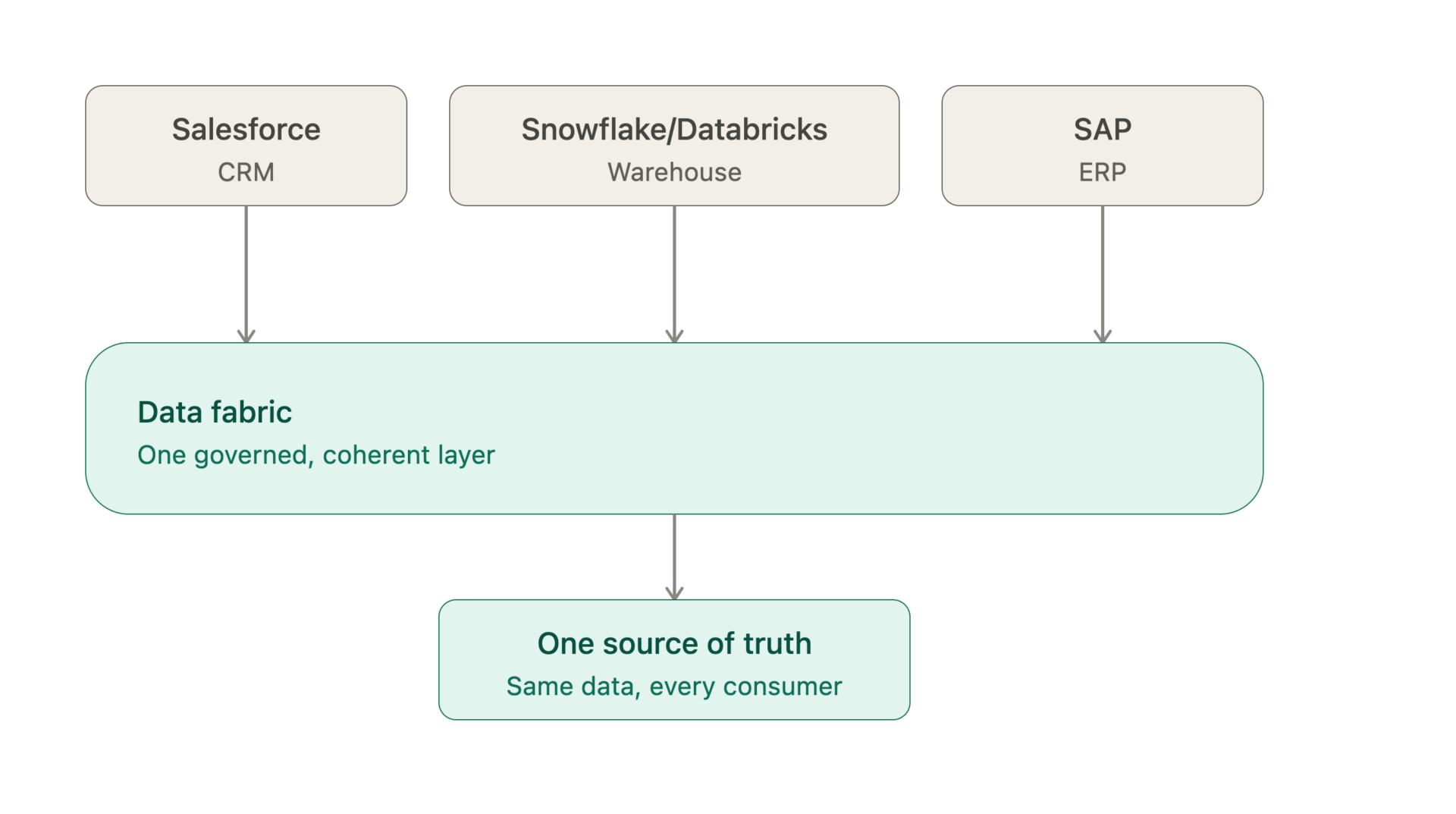
What is Data Fabric? A simplified view of how a data fabric connects existing systems (not an architectural blueprint).
A Concrete Example
Imagine a customer emails in with a shipping complaint. To resolve it well, an agent needs the order history, the shipment status, the warranty terms, the account’s SLA tier, and the relevant policy: five systems, at minimum.
Without a data fabric, an engineering team wires up five separate integrations, and each one interprets IDs and policy rules slightly differently. The agent gets partial information and sometimes gets it wrong. Nobody can easily trace why.
With a data fabric, those five systems are already connected through one governed layer. The agent queries it once and gets a complete, consistent answer, and the same layer is ready for the next agent you build, whether that’s for billing, retention, or internal support.
How to Start Without a Big-Bang Re-platforming
You don’t need to rebuild your entire data architecture to begin. A practical first step:
- Pick one workflow where missing context is already causing visible problems — customer service is a common starting point.
- Identify the handful of data sources that workflow actually needs.
- Connect and govern just those sources as your first slice of the fabric.
- Reuse that same layer for the next workflow, instead of starting over.
What is Data Fabric?
Data fabric isn’t a buzzword worth learning for its own sake but the answer to a very specific, very current problem: AI agents that need reliable, complete data to work safely at scale. As agentic workflows spread across the enterprise, the term is likely to move from niche to standard vocabulary, the way “cloud migration” did a decade ago.
FAQ
What is data fabric in simple terms?


It’s a layer that connects your existing data systems so any application can get one consistent, governed view of information, instead of engineers wiring up separate connections for every project.
Is data fabric a product I can buy?
No single product defines it. It’s an architectural pattern, usually built from a combination of catalog, pipeline, governance, and knowledge-graph tools layered over the systems you already run.
How is data fabric different from a data warehouse?
A warehouse stores and organizes data for analysis. Data fabric connects and governs data across multiple systems, including the warehouse, so it can be reused consistently by many applications, not just reporting tools.
Do I need data fabric if I'm not using AI agents yet?
It helps with any workflow that needs consistent data across systems. But agentic workflows are the reason it’s becoming urgent: agents fail quickly when the data behind them is inconsistent.
Does adopting data fabric mean replacing our current systems?
No. It sits on top of your existing CRM, ERP, and warehouse platforms rather than replacing them.
Category: