May 29, 2026
Automotive AI Statistics 2026: What the Data Says About SDVs, Smart Factories, and the Scaling Gap


Across the automotive industry, 92% of leaders acknowledge that becoming a software-driven organization is now a survival requirement, yet only 14% have successfully moved an AI initiative beyond a pilot stage.
This briefing presents the most relevant data points for executives evaluating where and how to invest in AI in 2026. It covers eight areas: market size and growth, software-defined vehicles, smart factory performance, predictive maintenance, the AI leadership gap, cybersecurity compliance, ADAS and autonomous vehicles, and workforce readiness.
KEY TAKEAWAYS
1. Market Size & Growth: Why the Numbers Vary
Automotive AI market forecasts for 2026 range dramatically – from $5.80 billion (Precedence Research) to $14.99 billion (Fortune Business Insights) to as high as $47.40 billion (Intel Market Research). These figures are not contradictory – they measure different things. The narrowest estimates cover only embedded AI software components.
Mid-range figures include software platforms and SDV systems. The broadest definitions incorporate the full hardware and cloud services stack. For executives, the precise number matters less than the directional consensus: every credible forecast projects sustained double-digit CAGR growth through 2034.
Zooming out to the broader software-defined vehicle opportunity, the scale becomes more striking. The global SDV market is projected to reach between $1.2 trillion (MarketsandMarkets) and $1.6 trillion (ResearchAndMarkets) by 2030.
Revenue from automotive software and electronics alone is projected to grow from roughly $80–100 billion today to $200–250 billion by the end of the decade.
2. Software-Defined Vehicles: The Mandate and the Execution Gap
The strategic urgency is not in dispute. According to the Capgemini Research Institute, 92% of automotive executives say their companies must become software-centric to survive the SDV transition, 87% view software capabilities as the primary competitive differentiator over the next five years, and 85% of engineering leaders report AI is now a core component of all vehicle software architectures.
On the ground, execution tells a different story. The 2026 SDV Reality Check — a survey of more than 550 automotive professionals across seven major markets by Omdia and Sonatus — finds OEMs pivoting away from selling vehicle data to third parties, shifting toward internal utilization: ADAS improvements (41% of data applications), product development (38%), and diagnostics.
The same report identifies a deepening “OTA trust crisis”: vehicle reliability and safety have now overtaken cybersecurity as the biggest barrier to OTA deployment.
The OTA market itself is growing rapidly regardless. The automotive OTA updates market is projected to reach between $15.75 billion (Grand View Research) and $20.2 billion by 2030 (Stratistics MRC), with SDV feature-related revenue, subscriptions, ADAS-as-a-service, OTA upgrades, growing at a 30–34% CAGR through 2035 (IDTechEx).
3. Smart Factory, Assembly Line & Quality Control
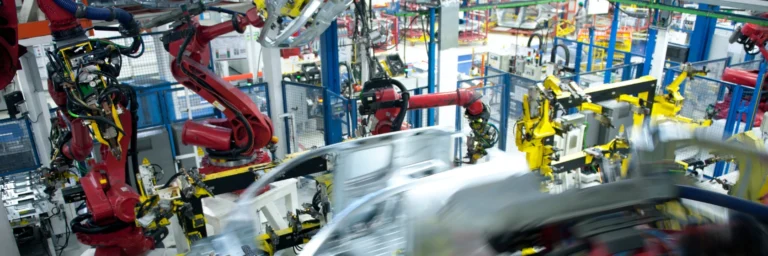
Deploying AI on the factory floor delivers an average 14% operational efficiency improvement, with manufacturers who establish unified edge-to-cloud data infrastructure projected to reach 24% optimization by 2029 (Capgemini Research Institute).
Smart factories integrating machine learning achieve a 10–12% gain in total manufacturing throughput and up to 20% improvement in overall production output (Vention).
The most extensively documented real-world benchmark comes from Volkswagen Group, which has deployed more than 1,200 AI applications across 43 manufacturing plants worldwide via its Digital Production Platform built on AWS. At its Poznań plant, AI-driven energy optimization reduced electricity consumption by 12%.
Its KI4UPS fault diagnosis application reduces electronic fault detection from hours to seconds, and VW can now roll out new production applications 2–3x faster than earlier methods.
Despite these results, preparedness to deploy at scale remains low across the industry. Rockwell Automation’s 2025 State of Smart Manufacturing — based on 1,560 manufacturers across 17 countries — found that 95% of manufacturers are investing in AI, yet only 20% are fully ready to deploy it in production.
Capgemini’s automotive-specific research found 72% of automotive firms classified as “novices” and only 10% as “frontrunners” capable of realizing full smart factory potential at scale.
The primary obstacle is not the AI model — it is the data pipeline: 78% of manufacturers automate less than half of their critical data transfers (Deloitte), and only 5% of automotive firms fully utilize 76–100% of their collected data (Rockwell Automation).
4. Predictive Maintenance, IoT & OEE
Predictive maintenance has emerged as the industry’s clearest AI ROI story. Smart diagnostics and predictive maintenance were cited by 34% of global respondents as their top AI priority in the 2026 SDV Reality Check — the #1 use case ahead of autonomous driving features and vehicle data monetization. Over 65% of new vehicles are expected to be equipped with predictive maintenance features by 2026.
The financial case is equally clear. Unplanned equipment downtime inflicts an estimated $50 billion annual cost across global manufacturing, stripping away between 5% and 20% of total productive capacity from a typical automotive plant (Deloitte).
Transitioning to continuous AI-driven telemetry monitoring reduces unplanned downtime by an average of 30–50%. The predictive maintenance market itself reached $14.93 billion in 2025 and is projected to grow at a 32.32% CAGR to reach $245.73 billion by 2035 (SNS Insider).
Execution gaps persist despite the clear ROI. German automakers rank predictive maintenance as a top after-sales revenue driver (47%), yet report the lowest AI deployment rate globally for this use case — just 18%. North American automakers show both higher prioritization (48%) and higher deployment rates (Omdia / Sonatus, 2026).
5. The AI Leadership Gap: Leaders vs. Laggards
The gap between organizations that have cracked AI scaling and those that have not is widening. The NTT DATA 2026 Global AI Report identifies that 93.2% of AI leaders embed AI directly into operational workflows — including engineering, manufacturing, OTA decision systems, and customer experience — while 38.6% are rebuilding core systems with embedded AI rather than layering tools on top of legacy architecture. Only 15% of all organizations currently qualify as AI leaders by these criteria.
The most sobering forward-looking signal comes from Gartner. Despite current investment enthusiasm, Gartner predicts only 5% of OEMs will maintain strong AI investment growth by 2029 — down from over 95% today — driven by unmet ROI expectations, integration challenges, and internal resistance (Gartner via Automotive World).
The implication is not that AI investment will prove unworthy — it is that most organizations will fail to execute well enough to justify continued commitment, concentrating returns further among those who have built durable software foundations.
Deloitte’s State of AI in the Enterprise 2026 confirms the bottleneck: only 25% of respondents have moved 40% or more of their AI pilots into production, and while worker access to AI rose by 50% in 2025, only 30% of organizations are redesigning key processes around it.
6. Cybersecurity, OTA Compliance & DevSecOps
As vehicles become rolling data centers and factories become interconnected network nodes, software compliance has become a critical operational vulnerability. 91% of automotive organizations admit they struggle to verify that supplier software meets functional safety and cybersecurity compliance standards (Capgemini Research Institute).
Today, 28% of global vehicles support full over-the-air updates — a figure projected to reach 66% by 2030, requiring a fundamental architectural shift toward unified chip-to-cloud platforms. In response, 75% of forward-looking OEMs have recentered their cybersecurity strategies around AI-driven real-time threat detection and continuous vulnerability scanning. Rockwell Automation’s automotive survey reinforces the urgency: 98% of automotive firms have adopted or plan to adopt cybersecurity platforms (Rockwell Automation, 2025).
7. ADAS, Autonomous Vehicles & the GenAI Opportunity
Beyond factories and maintenance, AI is reshaping the vehicle itself. The global ADAS market is valued at 361.4 million units in 2026, expected to reach 582.6 million units by 2033 (MarketsandMarkets). The broader autonomous vehicle market is projected to reach $5.4 trillion by 2035 at a 34.84% CAGR from a 2026 base of $364 billion (Precedence Research).
Generative AI is adding another layer. The generative AI in automotive market was estimated at $662.7 million in 2025, growing at a 27.3% CAGR through 2035 (GM Insights). S&P Global Mobility projects 28 million vehicles will feature GenAI-powered in-vehicle assistants by 2031.
Regional strategy is diverging sharply: Japan leads in automated driving prioritization — 50% of Japanese automakers rank it their top priority, up 10 points from 2025, while Chinese OEMs have pivoted dramatically away from data monetization toward automated driving (54%) and enhanced personalization (53%) (Omdia / Sonatus, 2026).
8. The Workforce & Skills Gap
Technology investment without workforce readiness produces shelf-ware. Rockwell Automation’s automotive-specific findings show 37% of manufacturers cite change management as their top workforce obstacle, and 41% are already using AI and automation to help close the skills gap. Nearly half of all manufacturing respondents (48%) now say the ability to apply AI is an extremely important skill — up from just 10% the prior year.
A sector-specific report commissioned by the Advanced Propulsion Centre UK (Coventry University, October 2025) found critical and widespread shortages in software engineering, AI, and embedded systems expertise.
Most employees are only “somewhat confident” using AI, and digital literacy gaps at a basic level — working with data dashboards, writing automation logic — are slowing adoption before it begins. Without urgent upskilling intervention, the industry risks over-reliance on overseas talent pipelines and losing the opportunity to scale domestic automotive AI capabilities.
Category: